Writer and Web page data
- This web page: https://www.globalissues.org/article/231/climate-justice-and-equity.
- To print all data (e.g. expanded aspect notes, exhibits various hyperlinks), use the print model:
On this web page:
- Why Don’t Poor International locations Have Emission Discount Targets?
- Widespread purpose however totally different tasks
- What may a justifiable share of emissions appear to be?
- Local weather negotiations ignoring social justice and fairness
- Wealthy Nations Have
Outsourced
Their Carbon Emissions - Politics and Pursuits
- Extra Data
Why Don’t Poor International locations Have Emission Discount Targets?
International warming is primarily a results of the industrialization and motorization ranges within the OECD nations, on whom the primary onus for mitigation presently lies.
It has lengthy been accepted that these industrialized nations which were industrializing because the Industrial Revolution bear extra duty for human-induced local weather change. It is because greenhouse gases can stay within the environment for many years.
With a little bit of historic context then, claims of fairness and equity tackle a unique that means than merely suggesting all nations needs to be lowering emissions by the identical quantity. However some industrialized nations seem to reject or ignore this premise.
Widespread purpose however totally different tasks
the US complained in regards to the obvious unfairness within the Kyoto Protocol, which doesn’t commit growing nations to the identical ranges of reductions in international warming pollution.
Nonetheless, what Washington has not point out is that the growing nations are NOT those who’ve induced the air pollution for the previous 150 or so years and that it will be unfair to ask them to chop again at for the errors of the at the moment industrialized nations.
Immediately’s Wealthy nations are chargeable for international warming
Greenhouse gases keep within the environment for many years. It’s not often talked about in Western mainstream media, however has been recognized for some time, because the Delhi-based Centre for Science and Setting (CSE) famous again in 2002:
Industrialized nations set out on the trail of improvement a lot sooner than growing nations, and have been emitting GHGs [Greenhouse gases] within the environment for years with none restrictions. Since GHG emissions accumulate within the environment for many years and centuries, the industrialized nations’ emissions are nonetheless current within the earth’s environment. Due to this fact, the North is chargeable for the issue of world warming given their enormous historic emissions. It owes its present prosperity to many years of overuse of the frequent atmospheric house and its restricted capability to soak up GHGs.
And naturally, this was enshrined within the frequent however differentiated tasks
precept a decade earlier than that.
It’s unfair to anticipate the third world to make emissions reductions to the identical stage as wealthy nations

In keeping with a Christian Help report (September 1999), industrialized nations needs to be owing over 600 billion {dollars} to the growing nations for the related prices of local weather modifications. That is thrice as a lot as the standard debt that growing nations owe the developed ones.
Because the above-mentioned WRI report additionally provides: A lot of the expansion in emissions in growing nations outcomes from the supply of fundamental human wants for rising populations, whereas emissions in industrialized nations contribute to progress in a lifestyle that’s already far above that of the typical particular person worldwide. That is exemplified by the massive contrasts in per capita carbons emissions between industrialized and growing nations. Per capita emissions of carbon within the U.S. are over 20 instances greater than India, 12 instances greater than Brazil and 7 instances greater than China.
Because the above-mentioned CSE additionally provides:
Creating nations, then again, have taken the highway to progress and improvement very lately. In nations like India, emissions have began rising however their per capita emissions are nonetheless considerably decrease than that of industrialized nations. The distinction in emissions between industrialized and growing nations is even starker when per capita emissions are taken under consideration. In 1996, for example, the emission of 1 US citizen equaled that of 19 Indians.
(The slight distinction in emissions capita quoted by the sources above are as a result of variations within the date of the info and the modifications that had taken place between.)
Moreover, many emissions in nations reminiscent of India and China are from wealthy nation firms out-sourcing manufacturing to those nations. Merchandise are then exported or offered to the wealthy. But, at the moment, the blame
for such emissions are placed on the producer not the buyer. It isn’t a clear-cut situation although, as some producers create merchandise and attempt to market them to customers to purchase, whereas different instances, there’s a market/client demand for sure merchandise. Corporations who can attempt to keep away from extra regulation and better wages in richer nations might try to off-shore such manufacturing. As mentioned on this web site’s consumption part, some 80% of the world’s assets are consumed by the wealthiest 20% of the world (the wealthy nations). This portion has been greater up to now, suggesting that these nations ought to subsequently bear the brunt of the targets. This situation is mentioned in additional element in varied a part of this web site’s commerce and financial points part.
Creating nations will even be tackling local weather change in different methods
Moreover, many growing nations are already offering voluntary cuts and as they develop into bigger polluters, they too might be topic to discount mechanisms.
A 2002 report from the Pew Middle for instance, highlights how key growing nations have been capable of considerably scale back their mixed greenhouse gasoline emissions by some 19 %, or 300 million tons a yr, with probably one other 300 million tons by 2010. These nations are Brazil, China, India, Mexico, South Africa, and Turkey.
Numerous efforts reported by Pew included:
- Market and vitality reforms to advertise financial progress;
- Growth of other fuels to scale back vitality imports;
- Aggressive vitality effectivity applications;
- Use of photo voltaic and different renewable vitality to lift dwelling requirements in rural areas;
- Lowering deforestation;
- Slowing inhabitants progress; and
- Switching from coal to pure gasoline to diversify vitality sources and scale back air air pollution.
This exhibits that the wealthy nations can and will have the opportunity to take action as properly.
An earlier report in 2000 from the WRI additionally notes that growing nations are already taking motion to restrict emissions (emphasis unique).
In a report, earlier nonetheless (1999), WRI additionally famous that:
These and plenty of, many different associated points have hardly obtained detailed protection both in any respect, or no less than concurrently the protection of US causes for backing out of Kyoto. Therefore it’s comprehensible why many US residents would agree with the Bush Administration’s place on this, for instance.
See this web site’s part on local weather change negotiations and actions and commerce associated points for extra on a few of these elements.
Politics and Pursuits
On the time of the top of the CoP-8 local weather change convention, what seems to be a change in precept by the European Union, in direction of the place of the growing nations has emerged. That’s, as Centre for Science and Setting (CSE) feedback, Denmark, at the moment president of the European Union, introduced yesterday [October 31, 2002] that growing nations wouldn’t get any cash for adapting to local weather change till they begin discussing discount commitments.
Not solely can this be described as blackmail, as CSE additionally spotlight, however as well as, wealthy nations themselves have shied away from their commitments, amounting to hypocrisy.
As CSE continued, Adaptation funds have been on the negotiations agenda for a number of years now. Industrialized nations, together with progressive nations like Denmark, have run away from committing something concrete, and growing nations haven’t been capable of pin down any legal responsibility on them.
(CSE has additionally been essential of leaders in growing nations who are equally in charge for encouraging the notion that they are often purchased
showing to reply to cash solely such, giving a chance for some wealthy nations to take advantage of that.)
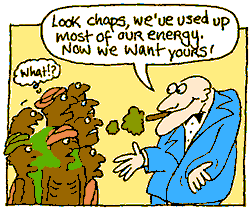
Economics and political agendas all the time makes it troublesome to provide a treaty that every one nations can agree to simply. The wealthier and extra highly effective nations are naturally capable of exert extra political clout and affect. The US, for instance, has pushed for various options that can enable it to keep up its dominance. An instance of that’s buying and selling in emissions, which has seen a variety of criticisms.
The best way present local weather change negotiations have been going sadly suggests the developed world will place themselves to make use of the land of the growing and poor nations to additional their very own emissions discount, whereas leaving few such straightforward choices for the South, as summarized by the next as properly:
Investments in
carbon sinks(reminiscent of large-scale tree plantations) within the South would end in land getting used on the expense of native folks, speed up deforestation, deplete water assets and improve poverty. Entitling the North to purchase low cost emission credit from the South, by means of initiatives of an typically exploitative nature, constitutescarbon colonialism. Industrialised nations and their firms will harvest thelow-hanging fruit(the most cost effective credit), saddling Southern nations with solely costly choices for any future discount commitments they may be required to make.
Savingthe Kyoto Protocol Means Ending the Market Mania, Company Europe Observatory, July 2001
Extra Data
For extra data on this, you can begin on the following hyperlinks:
- Fairness Watch from Delhi-based Centre for Science and Setting.
- Local weather Justice part of a scathing report on enterprise pursuits in local weather negotiations from the Company Europe Observatory.
- Fairness—Backside line or wishful pondering? from a report from PANOS on the Local weather Change Conference.
- This site’s part on the Kyoto convention that appears extra on the situation of growing nations and the US place.
- Local weather Justice from CorpWatch closely criticizes company pursuits and affect in local weather negotiations.
- Christian Help goes so far as criticizing the Kyoto protocol as a fraud due to the unfairness by wealthy nations. As they level out:
- 4.5 per cent of the world’s inhabitants lives within the USA and emits 22 per cent of the world’s greenhouse gases.
- 17 per cent of the world’s inhabitants lives in India and emits 4.2 per cent of the world’s greenhouse gases.
- Britain emits 9.5 tonnes of carbon dioxide per particular person per yr, whereas Honduras emits 0.7 tonnes per particular person.
- The world’s poorest nations account for simply 0.4 per cent of carbon dioxide emissions. 45 per cent of the world’s carbon dioxide emissions are produced by the G8 nations alone.
- EcoEquity supplies a variety of articles and commentary.
Writer and Web page Data
- Created:
- Final up to date: