The world’s top-performing system for graph processing at scale was constructed on a commercially accessible cluster.
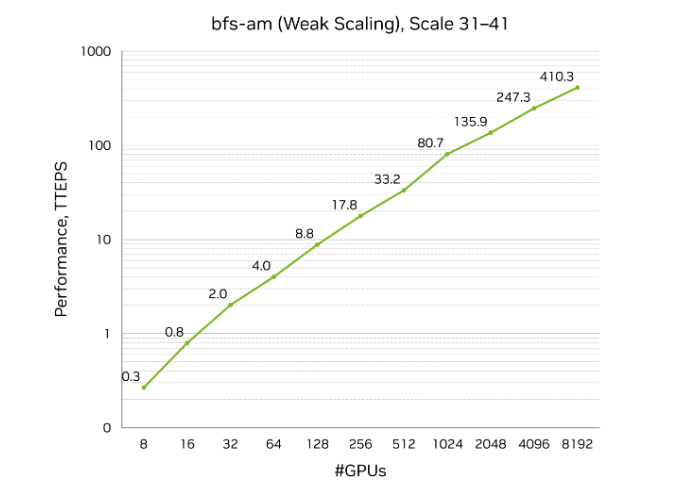
NVIDIA final month introduced a record-breaking benchmark results of 410 trillion traversed edges per second (TEPS), rating No. 1 on the thirty first Graph500 breadth-first search (BFS) record.
Carried out on an accelerated computing cluster hosted in a CoreWeave knowledge heart in Dallas, the successful run used 8,192 NVIDIA H100 GPUs to course of a graph with 2.2 trillion vertices and 35 trillion edges. This result’s greater than double the efficiency of comparable options on the record, together with these hosted in nationwide labs.
To place this efficiency in perspective, say each individual on Earth has 150 associates. This might signify 1.2 trillion edges in a graph of social relationships. The extent of efficiency just lately achieved by NVIDIA and CoreWeave allows looking out by each pal relationship on Earth in nearly three milliseconds.
Pace at that scale is half the story — the true breakthrough is effectivity. A comparable entry within the high 10 runs of the Graph500 record used about 9,000 nodes, whereas the successful run from NVIDIA used simply over 1,000 nodes, delivering 3x higher efficiency per greenback.
NVIDIA tapped into the mixed energy of its full-stack compute, networking and software program applied sciences — together with the NVIDIA CUDA platform, Spectrum-X networking, H100 GPUs and a brand new energetic messaging library — to push the boundaries of efficiency whereas minimizing {hardware} footprint.
By saving important time and prices at this scale in a commercially accessible system, the win demonstrates how the NVIDIA computing platform is able to democratize entry to acceleration of the world’s largest sparse, irregular workloads — involving knowledge and work gadgets that are available various and unpredictable sizes — along with dense workloads like AI coaching.
How Graphs at Scale Work
Graphs are the underlying info construction for contemporary know-how. Folks work together with them on social networks and banking apps, amongst different use circumstances, daily. Graphs seize relationships between items of knowledge in large webs of knowledge.
For instance, take into account LinkedIn. A consumer’s profile is a vertex. Connections or relationships to different customers are edges — with different customers represented as vertices. Some customers have 5 connections, others have 50,000. This creates variable density throughout the graph, making it sparse and irregular. Not like a picture or language mannequin, which is structured and dense, a graph is unpredictable.
Graph500 BFS has a protracted historical past because the industry-standard benchmark as a result of it measures a system’s means to navigate this irregularity at scale.
BFS measures the pace of traversing the graph by each vertex and edge. A excessive TEPS rating for BFS — measuring how briskly the system can course of these edges — proves the system has superior interconnects, similar to cables or switches between compute nodes, in addition to extra reminiscence bandwidth and software program capable of reap the benefits of the system’s capabilities. It validates the engineering of the complete system, not simply the pace of the CPU or GPU.
Successfully, it’s a measure of how briskly a system can “suppose” and affiliate disparate items of knowledge.
Present Methods for Processing Graphs
GPUs are recognized for accelerating dense workloads like AI coaching. Till just lately, the most important sparse linear algebra and graph workloads have remained the area of conventional CPU architectures.
To course of graphs, CPUs transfer graph knowledge throughout compute nodes. Because the graph scales to trillions of edges, this fixed motion creates bottlenecks and jams communications.
Builders use a wide range of software program methods to bypass this challenge. A typical strategy is to course of the graph the place it’s with energetic messages, the place builders ship messages that may course of graph knowledge in place. The messages are smaller and will be grouped collectively to maximise community effectivity.
Whereas this software program approach considerably accelerates processing, energetic messaging was designed to run on CPUs and is inherently restricted by the throughput fee and compute capabilities of CPU programs.
Reengineering Graph Processing for the GPU
To hurry up the BFS run, NVIDIA engineered a full-stack, GPU-only answer that reimagines how knowledge strikes throughout the community.
A customized software program framework developed utilizing InfiniBand GPUDirect Async (IBGDA) and the NVSHMEM parallel programming interface allows GPU-to-GPU energetic messages.
With IBGDA, the GPU can instantly talk with the InfiniBand community interface card. Message aggregation has been engineered from the bottom as much as assist lots of of hundreds of GPU threads sending energetic messages concurrently, in contrast with simply lots of of threads on a CPU.
As such, on this redesigned system, energetic messaging runs utterly on GPUs, bypassing the CPU.
This allows taking full benefit of the huge parallelism and reminiscence bandwidth of NVIDIA H100 GPUs to ship messages, transfer them throughout the community and course of them on the receiver.
Working on the secure, high-performance infrastructure of NVIDIA associate CoreWeave, this orchestration enabled doubling the efficiency of comparable runs whereas utilizing a fraction of the {hardware} — at a fraction of the associated fee.
Accelerating New Workloads
This breakthrough has large implications for high-performance computing. HPC fields like fluid dynamics and climate forecasting depend on comparable sparse knowledge buildings and communication patterns that energy the graphs that underpin social networks and cybersecurity.
For many years, these fields have been tethered to CPUs on the largest scales, whilst knowledge scales from billions to trillions of edges. NVIDIA’s successful outcome on Graph500, alongside two different high 10 entries, validates a brand new strategy for high-performance computing at scale.
With the full-stack orchestration of NVIDIA computing, networking and software program, builders can now use applied sciences like NVSHMEM and IBGDA to effectively scale their largest HPC purposes, bringing supercomputing efficiency to commercially accessible infrastructure.
Keep updated on the newest Graph500 benchmarks and study extra about NVIDIA networking applied sciences.