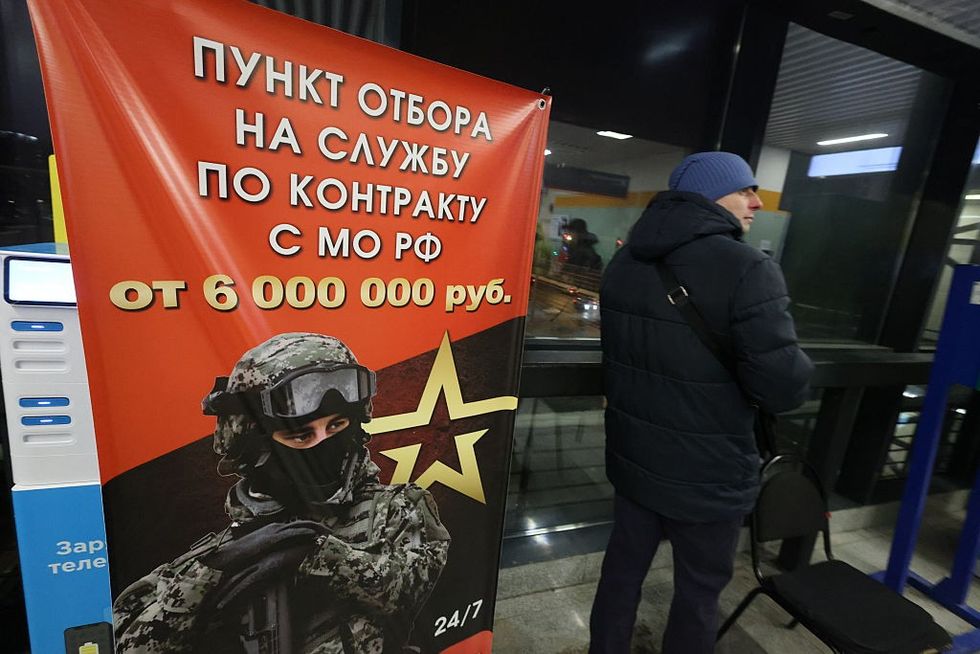
“Russia has no selection however to try to proceed its overseas recruitment mannequin given Russian army casualties and political realities of a big mobilization in President Putin’s political bases in Moscow and Saint Petersburg,” Alex Plitsas, nonresident senior fellow with the Center East Packages on the Atlantic Council, tells The Cipher Transient.
For Washington, the pipeline carries implications past the fast battlefield. Fight-hardened fighters from areas the place the USA competes with Russia for affect, significantly throughout Africa and Latin America, will finally return dwelling doubtlessly geared up with drone warfare experience, small arms proficiency, and tactical information gained in Europe’s most technologically superior land struggle since 1945.
Former AFRICOM commander Normal Stephen Townsend warned in 2019 that Russia’s meddling in Africa includes the “second greatest menace to US safety pursuits” after terrorism.
The Structure of Exploitation
Moscow has successfully turned its migration system right into a entice, routinely constructing army recruitment workplaces proper beside immigration services the place beatings and freezing cells are used to coerce signatures. Detention or army service are sometimes the one choices for migrants in authorized limbo.
Incentives are additionally used to take advantage of poverty. Nepali recruits obtain 75,000 to 200,000 rubles month-to-month, or $750 to $2,000, dwarfing native earnings however representing solely a fraction of Russian compensation. Cuban networks promise citizenship and beneficiant funds.
The Human Trafficking Pipeline
A number of governments now describe these recruitment ways as outright human trafficking. In Kenya, an investigation revealed that residents have been promised secure jobs solely to seek out themselves on drone meeting traces in lively struggle zones. India has documented an identical sample, with not less than 35 of its nationals despatched to the entrance traces towards their will.
Nepal maybe serves as essentially the most stark instance of this human price. Formally, 14 Nepalis are confirmed lifeless, however estimates counsel as many as 2,000 might have enlisted in Russian forces. The following outrage in Kathmandu led to Russia and Ukraine’s work permits being denied in early 2024. This proved efficient, not less than briefly, as just one identified Nepali citizen had signed a contract within the first ten months of 2025.
The scenario, nonetheless, is harrowing on the bottom. Overseas recruits are deployed to frontline assaults after only a week of coaching, in response to Ukrainian prisoners of struggle. Regardless of guarantees of non-combat roles, a few of these males signed Russian-language contracts they couldn’t even learn.
“The overseas recruits have confirmed to be much less efficient on account of the minimal quantity of coaching and poor gear that they obtain upon becoming a member of,” says Plitsas. “Russia is throwing our bodies on the downside, so to talk, by way of making an attempt to fortify the entrance traces and changing fallen Russian troops.”
Subscriber+Members get unique entry to expert-driven briefings on the highest nationwide safety points we face immediately. Achieve entry to save lots of your digital seat now.
The political calculus is deliberate. Plitsas highlights that there are far fewer political ramifications for dropping overseas fighters than for Russian residents.
“Many see these foreigners as having volunteered, so in the event that they die in fight, it doesn’t have a big reflection inside Russian society,” he continues.
Central Asian migrants face specific vulnerability.
Moscow has more and more turned its consideration to the 4 million Central Asian migrants dwelling inside its borders to unravel its mounting personnel shortages. Because the authorized shifts in September 2022, the Kremlin has successfully tied residency and citizenship to army service.
Uzbeks and Tajiks working in Russia face a pressured selection: enlist or lose their authorized standing. It is not uncommon for brand spanking new arrivals’ residency functions to be stalled until they signal a army contract, making them a primary goal for Russian recruiters.
The Manpower Calculus
Moscow’s reliance on overseas recruits displays an acute pressure on its capacity to maintain fight operations. Western estimates counsel Russia has suffered roughly 1.2 million casualties — killed and wounded — since February 2022. The UK Ministry of Protection reported Russia misplaced roughly 415,000 personnel in 2025 alone, the second-deadliest 12 months of the battle. December 2025 averaged 1,130 casualties day by day, marking 4 consecutive months of rising losses.
The Kremlin maintains a month-to-month recruitment fee of roughly 30,000 to 40,000 contract troopers, roughly matching battlefield attrition charges. This tempo requires exploiting each out there demographic, with provincial governments pressured to satisfy quotas.
But debate exists over the dimensions’s significance.
“The Russian military doesn’t rely critically on overseas mercenaries,” Oleg Ignatov, Senior Analyst for Russia on the Disaster Group, tells The Cipher Transient. “The precise variety of overseas mercenaries within the Russian military is unknown, however it’s small in comparison with the entire variety of troops.”
Impartial estimates hover round 1,500, whereas Russian officers declare 30,000 complete — a fraction of Russia’s roughly 700,000 troops in Ukraine.
“Total, there is no such thing as a proof that overseas mercenaries stand out amongst Russian troopers and undergo vital losses in comparison with different troopers,” Ignatov insists, noting North Korean forces initially suffered heavy losses as a result of “they weren’t tailored to the realities of struggle in Ukraine.”
“All different foreigners serve in Russian items and undergo the identical losses as all different servicemen in these items,” he says.
The sample displays a broader strategic actuality.
In line with Ignatov, “each Russia and Ukraine are experiencing a scarcity of manpower for one of these struggle, which explains their efforts to recruit foreigners.”
“As well as, Russia wants to take care of its manpower benefit on the entrance traces, which it gained by the tip of 2023-early 2024,” he factors out.
Plitsas frames the crucial extra starkly.
“Russia has no selection however to try to proceed its overseas recruitment mannequin given Russian army casualties and political realities of a big mobilization in President Putin’s political bases in Moscow and Saint Petersburg,” he notes.
That political threat grew to become clear greater than three years in the past. Moscow stays cautious of the home fallout that adopted the September 2022 mobilization. The Kremlin thus depends on overseas recruitment to take care of frontline numbers.
The Safety Aftermath
The long-term safety implications of Russia’s overseas recruitment prolong far past the battlefield. Fight veterans returning to impoverished dwelling nations carry specialised army expertise from Europe’s largest land struggle since 1945. Historic precedent from Afghanistan, Syria, and Iraq demonstrates that even small percentages can destabilize areas.
“Overseas fighters returning dwelling typically undergo from the identical varieties of combat-related stress problems as troops however provided that they have been working for a overseas army, they don’t get advantages after they return to their dwelling nation,” Plitsas cautions. “In addition they have adequate coaching to have the ability to conduct assaults at dwelling, even when they’re simplistic, involving solely small arms.”
The psychological and sensible dangers compound.
“There’s at all times a threat in having a inhabitants of combat-experienced fighters who lack entry to advantages and therapy for combat-related points and their susceptibility to home causes that might be problematic for his or her dwelling governments,” Plitsas underscores, pointing to Syria. “Many overseas fighters returned from Iraq with fight expertise and helped to type the bottom of the armed factions that overthrew the Assad regime.”
Past bodily fight expertise, the technological information poses distinct risks.
“One concern is that overseas fighters will speed up the proliferation of drone applied sciences and ways utilized in Ukraine to nefarious teams world wide, a few of which have already began adopting them,” John Hardie, deputy director of the Russia Program on the Basis for Protection of Democracies, tells The Cipher Transient.
Ukraine has change into a laboratory for drone warfare. Veterans returning with hands-on expertise may quickly advance militant and legal capabilities from Latin America to Southeast Asia.
Some nations are attempting, or tried, to push again.
Kazakhstan opened a file 709 legal instances in 2025 towards residents who joined Russian formations, with sentences starting from 4.5 to five years. Kyrgyzstan’s try and set a authorized precedent, nonetheless, fell flat when the Kremlin stepped in with stress to drop fees.
Regardless of the dying toll of greater than 120 Uzbek, Tajik, and Kyrgyz fighters by late 2024, accountability stays nonexistent. It is not uncommon for recruits to cover behind new Russian passports, which legally place them past the attain of their dwelling governments. The true fear now isn’t simply the lifeless, however the survivors; males who keep in Russia with specialised fight coaching and no clear path besides drifting into the legal margins.
For Cuba, which joined the Russian-led BRICS bloc, estimates counsel as much as 20,000 Cubans recruited since 2022, with 200 to 300 killed. El País reported that 40 p.c had beforehand served within the Cuban Armed Forces, suggesting state consciousness. Because of the excessive proportion of lively army personnel and ex-military personnel combating beneath the Russian banner, Cuba’s authorities could also be tacitly allowing the recruitment pipeline.
In contrast to Nepal or India’s aggressive crackdowns, Havana’s muted response raises questions on quid professional quo preparations with Moscow, significantly as Cuba faces a extreme financial disaster and relies upon closely on Russian assist.
“Journey bans and efforts by governments to cease their residents from volunteering can have some influence, although the general numbers are nonetheless small on the whole phrases,” Plitsas observes. “Augmenting Russian troops with overseas troops has additionally confirmed to be environment friendly, although poor coaching and gear restrict general effectiveness.”
The offensive exploits world inequality whereas exporting prices to nations with restricted pushback capability. Whereas Moscow claims overseas recruits reveal worldwide assist for the struggle, the fact is far bleaker: it’s a trafficking operation that targets the poor and determined. The identical factor occurred in Syria and Iraq, demonstrating to the worldwide group {that a} handful of combat-hardened veterans can destabilize a whole nation.
When these males return to Africa or South Asia with experience in drone strikes and concrete warfare, they typically don’t simply return to civilian life; they change into a ready-made package for insurgencies or legal teams.
“Overseas governments have taken some steps to attempt to stem the circulation of overseas fighters supporting Russia, however the populations concerned have been comparatively small, and it hasn’t been seen as a big sufficient downside for dwelling governments to take extra vital motion so far,” Plitsas explains.
He identifies structural challenges.
“Lots of the fighters come from nations which can be pleasant to Russia, and so banning journey, or issues of that nature, turns into tougher given the standing of the connection between the nations,” Plitsas continues. “Additionally, whenever you’re touring overseas and want a visa, the nation you’re touring to has to grant it to you. Russia is incentivized to permit the circulation to proceed, because the burden is on Russia to grant the visa, not the house nation. It makes policing the trouble very tough.”
As battlefield casualties mount and home constraints forestall mobilization, overseas recruitment gives an important launch valve for Moscow. Because of this, 1000’s of individuals have been channeled into struggle beneath false pretenses, leaving survivors scarred and geared up with army expertise posing long-term safety dangers.
But Ignatov pushes again towards the alarmist framing.
“Conflict is a critical trauma, and all troopers want psychological assist. However I don’t assume there are any dangers of radicalization past this downside,” he contends. “There is no such thing as a radical ideology in Russia that poses a menace of world unfold.”
Whether or not ideological or not, the sample is obvious: Russia’s manpower disaster exhibits no signal of abating.
The Cipher Transient is dedicated to publishing a spread of views on nationwide safety points submitted by deeply skilled nationwide safety professionals. Opinions expressed are these of the writer and don’t signify the views or opinions of The Cipher Transient.
Have a perspective to share primarily based in your expertise within the nationwide safety discipline? Ship it to [email protected] for publication consideration.
Learn extra expert-driven nationwide safety insights, perspective and evaluation in The Cipher Transient as a result of Nationwide Safety is Everybody’s Enterprise