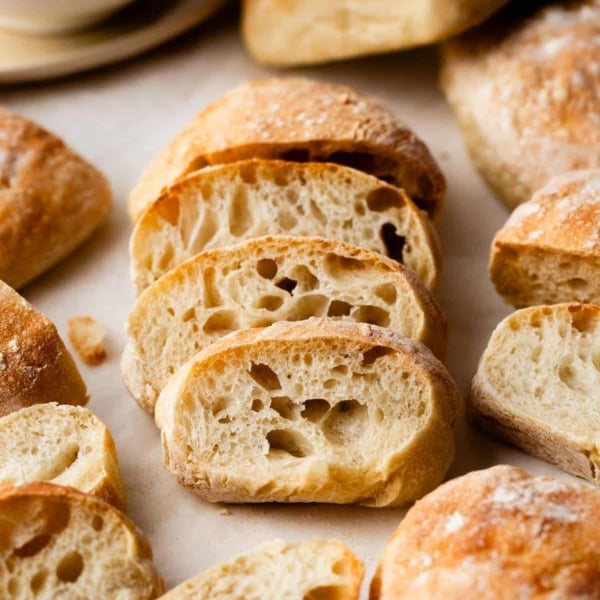
Learn to make home made ciabatta bread with this thorough step-by-step recipe as your information. Rustic-looking and flavorful, with a flour-dusted crusty exterior and extra-chewy inside pockmarked by air bubbles, this basic Italian-style bread is constructed from simply 4 components: flour, yeast, water, and salt. Making this bread is a 2-day course of, however step one on day one takes simply 5 minutes.

Ciabatta is a uniquely crusty, chewy bread that’s good for dipping in olive oil or absorbing soup or sauce. At the moment I’m displaying you make each ciabatta bread AND ciabatta rolls, each from the identical dough. The rolls, when sliced horizontally, make an ideal base for a hearty sandwich or panini. Tuna soften, BLT, caprese pesto rooster burger, eggs and avocado, you title it—it’s a sturdy sandwich roll that stands as much as all of it.
Bonus: Because it stales, day-old ciabatta makes for scrumptious crostini, or a unbelievable breakfast casserole or strata. (I used it in our Christmas brunch sausage & egg casserole!)
What Is Ciabatta?
Ciabatta (pronounced chuh-bah-tuh) is the Italian phrase for slipper, and this sort of bread was given its moniker in reference to its attribute flat, broad, elongated form. A country Italian white bread just like my home made artisan bread, ciabatta dough is constructed from the only of components: flour, water, salt, and yeast.
The important thing distinction between in the present day’s recipe and my artisan bread lies within the ciabatta’s enhanced taste, crispier crust, and irresistibly ethereal inside. These three standout qualities are achieved by prolonged fermentation and a exact sequence of dough-folding steps between rests.
If you happen to’re searching for one thing simpler, begin with my artisan bread!


Ciabatta Bread Success Suggestions
Between growing, testing, and photographing this recipe, there have been a minimum of 15 batches of ciabatta bread going by my kitchen the previous few months. I’ve discovered lots by the method and I’m thrilled to share all of it with you… each the wins and the fails.
This isn’t a real ciabatta recipe, that means we aren’t making it utilizing the *actual conventional methodology* you’ll be taught in a bread class at an Italian culinary faculty. However this barely simplified methodology yields outcomes which might be fairly darn shut.
General, in the present day’s recipe is an efficient introduction to creating preferment breads, and a dwelling baking undertaking that you simply’ll really feel proud to perform.
Earlier than we get began, I need to name out two key facets of constructing ciabatta bread from scratch:
- Make a preferment the day earlier than. Step one is to make a preferment (aka biga)—a easy combination of flour, water, and a pinch of yeast, which wants to take a seat in a single day earlier than utilizing within the ciabatta dough. The biga assists in each taste and construction. It helps strengthen the gluten, making for a chewier texture, and offers a extra advanced taste as nicely.
- Anticipate an extra-sticky dough. This kind of bread makes use of a excessive hydration (aka very moist) dough, sometimes a minimum of 80% hydration. The upper the hydration (and the longer you let the dough relaxation), the extra versatile the gluten turns into, and the chewier the ultimate bread will likely be. As a result of it’s so moist and sticky, this dough is unimaginable to knead by hand, and as an alternative requires a mild “stretch and fold” methodology for constructing energy within the dough. Take note of the wording within the directions; at instances I instruct you to deal with the dough with oiled fingers or instruments, and at different instances with generously floured fingers or instruments. These particular instructions are there to assist make this sticky, extremely hydrated dough simpler to work with.
Useful Instruments for Making Ciabatta Bread
- Kitchen Scale: When you have one, use a kitchen scale to measure your components by weight (in grams). You need to keep away from including an excessive amount of flour to this dough—the wetter and stickier it’s, the higher. Measuring by weight is most correct, and can put you on the trail to home made ciabatta success. If you happen to don’t have a scale, be certain to make use of the spoon & degree methodology reasonably than scooping the flour out of the container with the measuring cup.
- Bench Scraper: With this sticky dough, a bench scraper is mainly an extension of your fingers. It helps you form and neatly straighten the dough, with out your fingers getting lined in slick, moist dough.
- Instantaneous-Learn Thermometer: An instant-read thermometer can also be useful to make use of right here. Each for checking the water temperature earlier than mixing it with the opposite components, and to examine the baked rolls for doneness. Whereas not required, a thermometer merely takes away the guesswork.
And for those who’re new to yeast, reference my Baking with Yeast Information for solutions to widespread yeast FAQs.
Solely 4 Components within the Dough
The crustier and chewier the bread, the much less fats within the dough—also called a “lean dough.” We’re utilizing a lean dough for these ciabatta rolls in the present day.

- Bread Flour: Whereas you should utilize all-purpose flour on this recipe, I strongly advocate utilizing bread flour. Identical to after we make olive bread and asiago-crusted skillet bread, bread flour produces a stronger, chewier crumb, and that makes an enormous distinction in a recipe with solely 3 different components.
- Instantaneous or Lively-Dry Yeast: You need to use both (see recipe Notice beneath). Take notice that you’ll not use a complete customary packet of yeast.
- Salt: You simply can’t make good bread with out salt—it’s important for taste. Common desk salt is what you want for this recipe.
- Water: Some yeasted bread recipes, like my gentle dinner rolls, name for heat liquid as a result of it helps the yeast work sooner. On the opposite finish of the spectrum, bread recipes with a protracted relaxation time, like this no-knead honey oat bread, name for cool or room-temperature water. The cooler the water, the longer the dough takes to rise and, normally, the higher the bread’s taste. (That is vital as a result of there are so few components so as to add substantial taste!) On this recipe, we’re utilizing BOTH. You’ll use cool or room-temperature water within the biga, or preferment, on day 1; then you definately’ll use heat water within the dough on day 2, to extend and velocity up the yeast’s exercise.
- Olive Oil: Whereas not within the dough itself, olive oil is useful for coating your fingers or spatula throughout the stretch-and-fold course of, stopping sticking and making dealing with the dough a lot simpler.
Plus, an invisible ingredient: time. Time is the superior taste enhancer. The preferment, permitting the dough to relaxation between stretches and folds, and at last proofing the dough after shaping all work collectively to develop taste.
Overview: Learn how to Make Ciabatta Bread & Ciabatta Rolls
It could look like a protracted course of, however needless to say more often than not is hands-off, whereas the dough rests.
Day 1:
- Combine collectively the preferment. Cowl and let sit at room temperature for 8–24 hours.
Day 2:
- Dissolve yeast in water. Add the preferment, flour, and salt. Combine to type a sticky, uniform dough. I normally do that by hand with a silicone spatula, however you should utilize a stand mixer and dough hook attachment. Don’t use a handheld mixer—the sticky dough would get caught within the beaters.
- Cowl and let the dough relaxation for half-hour.
- Stretch and fold the dough.
- Cowl and let relaxation for half-hour.
- Stretch and fold the dough.
- Cowl and let relaxation for half-hour.
- Stretch and fold the dough.
- Cowl and let relaxation for half-hour.
- Stretch and fold the dough for the 4th and last time.
- Refrigerate the dough for 1 hour, and as much as 24 hours.
- Form the rolls.
- Cowl and let relaxation for 1 hour. In the meantime, preheat the oven.
- Bake.
Learn how to Stretch & Fold Sticky Dough
After you make the dough with the preferment/biga, let it relaxation for half-hour to assist loosen up the gluten.
Have somewhat bowl of olive oil readily available. Frivolously grease your hand or a silicone spatula with the oil. Utilizing your greased hand or spatula, raise up one facet of the dough and gently stretch it up and pull it towards the other facet of the bowl, folding it down over the dough. I like to visualise a clock on high of the dough for this. You’ll be folding it on the 12 o’clock mark and pulling it down over the 6 o’clock mark. Then, flip the bowl 90 levels and repeat. Do that till you’ve gone across the bowl twice, for a complete of 8 folds.

The stretch-and-fold methodology is just like kneading dough however a lot gentler and extra exact; it’s designed to deal with the dough’s stickiness with out overworking it.
After every stretch and fold, let the dough relaxation for half-hour. Repeat this course of three extra instances, resting half-hour between every. With every spherical, you’re step by step constructing the dough’s energy and construction!
After the 4th spherical, refrigerate the dough for an hour and as much as 1 day. Sure, you may stretch this course of over 3 days if you’d like. I all the time admire a versatile baking recipe!
Learn how to Form Ciabatta Bread & Rolls
Generously flour your counter/work floor. Utilizing evenly oiled fingers or a evenly oiled spatula, gently scrape the dough out of the bowl and onto the floured floor. Sprinkle flour everywhere in the high, then gently pat into a ten×7-inch rectangle, or wherever near that dimension.

With a floured bench scraper, minimize in half down the middle, after which minimize every into 4 rectangles.

OR, for 2 loaves, minimize in half as soon as, horizontally, to make two 5×7-inch rectangles. (Or as soon as vertically for 2 10×3.5-inch loaves.)
With floured fingers and utilizing a floured bench scraper to help, fastidiously switch to parchment paper. Reshape the rolls/loaves as wanted, however don’t go nuts over this. It’s completely effective if the shapes are all somewhat wonky and uneven—ciabatta bread is supposed to look rustic!
Closing nap earlier than baking: Frivolously flour the tops of the ciabatta rolls after which cowl them with a clear kitchen towel. Let the rolls relaxation for 1 hour at room temperature.
For a Crispy Crust, Bake With Steam
In the meantime, place a flat cookie sheet or a rimmed baking sheet on the middle rack of your oven. Preheat to 450°F (232°C). You need your oven and baking floor to be heating for about an hour earlier than the bread goes in.
When able to bake, scatter a number of cups of ice cubes in a big shallow steel roasting pan, cast-iron skillet, or rimmed baking sheet. Why? You need to create steam in your oven. A moist, steamy atmosphere is essential for ciabatta to develop its signature golden-crisp crust. It additionally retains the dough’s floor moist within the first couple of minutes of baking, which permits it to develop with out cracking.
Uncover the rolls and evenly spray or flick them with somewhat water. Why? Extra steamy moisture. See above.
Working shortly, fastidiously pull out the oven rack with the preheated baking sheet and slide the parchment paper and proofed bread onto it. Slide the pan with the ice cubes onto the underside oven rack and shortly shut the oven door, trapping the steam from the melting ice inside.
Lastly, your bread is baking. It can take about 20 to 22 minutes, or as much as 25 minutes for a deeper golden coloration. All ovens are totally different, so use an instant-read thermometer when you’ve got one to examine the interior temperature of the bread. You’re searching for round 205°F (96°C) to 210°F (99°C).

Closing Success Tip
To make sure the inside units correctly, cool the bread or rolls for a minimum of 45 minutes earlier than slicing and serving. Reducing too early will go away you with a gummy texture.
Recent or dried herbs are finest for flavoring this ciabatta dough. My favourite is contemporary or dried rosemary with somewhat garlic. When including the salt in step 2 beneath, add 2 and 1/2 teaspoons contemporary chopped rosemary or 1 teaspoon dried, plus 2 minced garlic cloves. Be at liberty to exchange the rosemary with one other herb.
If you wish to bake your bread/rolls on a pizza stone, preheat the pizza stone within the oven. In step 10 beneath, place the formed and scored dough in your preheated pizza stone. Bake as directed.
Sure. Generously grease a 9×13-inch baking pan with olive oil. After finishing step 5 beneath, pour the dough into the greased pan. Flip to coat all sides within the oil. Stretch and flatten the dough to suit the pan. Don’t tear the dough. If it’s shrinking, cowl it with a clear towel and let it relaxation for five–10 minutes earlier than persevering with. This lets the gluten settle and it’s a lot simpler to form after that. Proceed with step 7 in my focaccia recipe.
To rely solely on a sourdough starter and never yeast, I like to recommend searching for a sourdough ciabatta bread recipe. To mix your energetic sourdough starter with yeast, nonetheless, you may merely substitute some flour and water with sourdough starter. Put together the biga beneath as instructed, then on day 2/in step 2 beneath, substitute 50g every water and flour with 100g of sourdough starter. Proceed with the recipe.


Do-it-yourself Ciabatta Bread
- Prep Time: 13 hours (contains rests & rises)
- Cook dinner Time: 25 minutes
- Complete Time: 14 hours, 10 minutes (contains cooling)
- Yield: 8 rolls or 2 flat loaves
- Class: Bread
- Technique: Baking
- Delicacies: Italian
Description
Rustic-looking and flavorful, with a flour-streaked crusty exterior and extra-chewy inside pockmarked by air bubbles, this basic Italian-style bread is constructed from simply 4 components. Making these ciabatta rolls is a 2-day course of. For finest success, I strongly advocate studying by the recipe earlier than you get began. Don’t be shy with the flour when flouring the work floor and your fingers. Use as a lot as it’s essential deal with the dough. When you have one, use a kitchen scale to measure your components by weight (in grams). With this sticky dough, a bench scraper is mainly an extension of your fingers. It helps you form and neatly straighten the dough.
Biga/Preferment
Ciabatta Rolls
Directions
- Day 1: Make the biga/preferment: In a big mixing bowl, whisk collectively the bread flour and yeast. Add the water and blend with a silicone spatula till mixed. Cowl the bowl tightly with plastic wrap and let relaxation at room temperature for 8–24 hours.


- Day 2: Make the dough: Uncover the bowl with the biga. In a separate giant mixing bowl, or the bowl of your stand mixer fitted with a dough hook attachment (don’t use a handheld mixer for this), whisk collectively the yeast and heat water. Cowl and let sit for five to 10 minutes till the yeast has dissolved. Add the biga, flour, and salt. Gently combine along with a silicone spatula or wood spoon, or utilizing the dough hook on medium velocity. The dough will appear dry and shaggy at first, however hold working it till all of the flour is moistened and the dough is uniform in texture (no dry pockets). If wanted, evenly grease your fingers with olive oil and gently knead the components collectively within the bowl. The dough will likely be moist and sticky; that’s regular, anticipated, and inspired.


- 1st relaxation: Cowl the bowl and let the dough relaxation for half-hour at room temperature.
- 1st stretch-and-fold: Visualize a clock on high of your dough. You’ll be folding it on the 12 o’clock mark. With an olive oil-greased spatula or evenly oiled fingers, raise up the dough at 12 o’clock and gently stretch it up and pull it towards the other facet of the bowl (6 o’clock), folding it down over the dough. Flip the bowl 90 levels and repeat. Do that till you’ve gone across the bowl twice, for a complete of 8 folds. Cowl the bowl and let relaxation for half-hour at room temperature.
- Remaining stretch-and-folds: Repeat step 4 three extra instances, permitting the dough to relaxation for half-hour between every. After the 4th stretch-and-fold, cowl the bowl and place it within the fridge for a minimum of 1 hour and as much as 24 hours.
- Form the rolls/bread: Very generously flour your counter or work floor. Utilizing evenly oiled fingers or a evenly oiled spatula, gently scrape the dough out of the bowl and onto the floured floor. Generously sprinkle flour on high of the dough. Utilizing floured fingers, gently stretch and form the dough right into a tough rectangle form, about 10×7 inches in dimension. For 8 rolls: With a floured bench scraper, minimize the dough into 8 items roughly equal in dimension, every round 2.5×3.5 inches (doesn’t should be good). For two loaves: With a floured bench scraper, minimize the dough in half to make two 5×7-inch (or 10×3.5-inch) rectangles.

- Frivolously flour a chunk of parchment paper. With floured fingers, and utilizing the floured bench scraper to assist, raise the sticky dough items up and switch them to the floured parchment, arranging them a minimum of 2 inches aside to make room for increasing. Take care to be additional light since you don’t need to deflate the dough. If the items of dough misplaced form throughout the switch, gently reshape into rectangles. (It’s effective in the event that they aren’t good—ciabatta bread is supposed to look rustic!)
- Proof Earlier than Baking: Frivolously sprinkle flour over the rolls, after which gently cowl them with a clear kitchen towel or piece of parchment paper. Let relaxation at room temperature for 1 hour.
- In the meantime, place one oven rack within the very backside place and one other rack within the heart/center place. Place a flat cookie sheet or a rimmed baking sheet on the middle rack. Preheat the oven to 450°F (232°C). You need your oven and baking floor to be heating for about an hour earlier than the bread goes in.
- When able to bake, scatter a number of cups of ice cubes in a big shallow steel roasting pan, cast-iron skillet, or rimmed baking sheet (don’t use glass). Uncover the rolls and evenly spray or flick them with somewhat water. (That is non-compulsory, however it helps create much more steam, which guarantees a crispier crust.) Working shortly, fastidiously take away the preheated baking sheet from the oven and slide the parchment paper and proofed bread onto it. Place again within the oven. Slide the pan with the ice cubes onto the underside oven rack and shortly shut the oven door, trapping the steam from the melting ice inside.
- Bake for 20–22 minutes, or till the bread/rolls are golden brown. I normally prolong this time to 25 minutes, for a deeper golden coloration. Gently faucet the bread—in the event that they sound hole, they’re achieved. For a extra correct check of doneness, the bread is finished when an instant-read thermometer inserted within the bread reads 205°F (96°C) to 210°F (99°C).
- Take away the rolls from the oven and permit to chill for a minimum of 45 minutes earlier than slicing and serving. If you happen to minimize into the bread too early, it is going to possible have a gummy texture.
- Retailer leftovers loosely lined at room temperature for as much as 5 days or within the fridge for as much as 1 week.
Notes
- Make Forward & Freezing Directions: There are lots of methods to make this dough forward of time. First, in step 1, the biga can sit for as much as 24 hours. Second, in step 5, after you may have accomplished the entire stretch-and-folds, the dough can sit within the fridge for as much as 24 hours. You can even bake the bread, permit it to chill, and freeze for as much as 3 months. Thaw at room temperature earlier than serving.
- Particular Instruments (affiliate hyperlinks): Kitchen Scale | Glass Mixing Bowls | Stand Mixer | Silicone Spatula or Picket Spoon | Bench Scraper | Baking Sheets | Instantaneous-Learn Thermometer | Cooling Rack
- Flour: For best possible taste and chewy texture, I strongly advocate utilizing bread flour. You need to use a 1:1 substitution of all-purpose flour in a pinch with no different adjustments to the recipe, nonetheless the dough will not be as sturdy, and will not maintain form very nicely. Don’t use whole-wheat flour on this dough.
- Yeast: You need to use instantaneous or energetic dry yeast, however I extremely advocate an instantaneous (aka “speedy rise” or “fast rise” yeast). If utilizing energetic dry yeast, there are not any adjustments wanted to the recipe.
- Including Herbs/Flavors: Recent or dried herbs are finest for flavoring this dough. My favourite is contemporary or dried rosemary with somewhat garlic. When including the salt in step 2, add 2 and 1/2 teaspoons contemporary chopped rosemary or 1 teaspoon dried, plus 2 minced garlic cloves. Be at liberty to exchange the rosemary with one other herb, and/or omit the garlic.
- Can I Bake on a Pizza Stone? Sure. If you wish to bake your bread/rolls on a pizza stone, place the pizza stone within the preheating oven for 1 hour. In step 10, place the formed and scored dough in your preheated pizza stone. Bake as directed.
- Can I Use This Dough for Focaccia? Sure. Generously grease a 9×13-inch baking pan with olive oil. After finishing step 5, pour the dough into the greased pan. Flip to coat all sides within the oil. Stretch and flatten the dough to suit the pan, being cautious to keep away from tearing the dough. If it’s shrinking again as you attempt to stretch it out, cowl with a clear towel and let it relaxation for five–10 minutes earlier than persevering with. This lets the gluten settle and it’s a lot simpler to form after that. Proceed with step 7 in my focaccia recipe.
- Can I Use a Sourdough Starter for This Recipe? To rely solely on a sourdough starter and never yeast, I like to recommend searching for a particular sourdough ciabatta bread recipe. To mix your energetic sourdough starter with yeast, nonetheless, you may merely substitute some flour and water with sourdough starter. Put together the biga beneath as instructed, then on day 2/in step 2, substitute 50g every water and flour with 100g of sourdough starter. Proceed with the recipe.
- Reference my Baking with Yeast Information for solutions to widespread yeast FAQs.
- Technique and recipe tailored from King Arthur Baking.
Vitamin
- Serving Dimension: 1 roll
- Energy: 233
- Sugar: 0.2 g
- Sodium: 437.5 mg
- Fats: 2.8 g
- Carbohydrates: 43.7 g
- Protein: 7.4 g
- Ldl cholesterol: 0 mg
Supply hyperlink