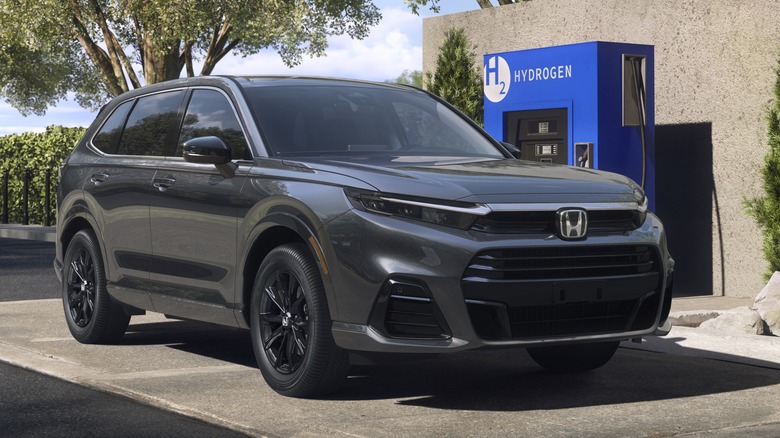
All vehicles are difficult and complicated machines, and that complication and intricacy multiply when cutting-edge applied sciences are concerned. There are millions of parts in each new car, and generally, shockingly, a number of of them go improper. That is what’s taking place with the 2025 Honda CR-V e:FCEV, for which NHTSA has issued a recall. Honda says there is a potential for gasoline cell stack coolant to leak into the gasoline cell stack case, the place it could create an inside quick circuit that would trigger a lack of drive energy.
For those who’re driving one of many 388 CR-V e:FCEVs concerned on this recall, Honda believes there is a 60% likelihood that your automobile is bothered with the issue. Based on the automaker, there are two potential causes:
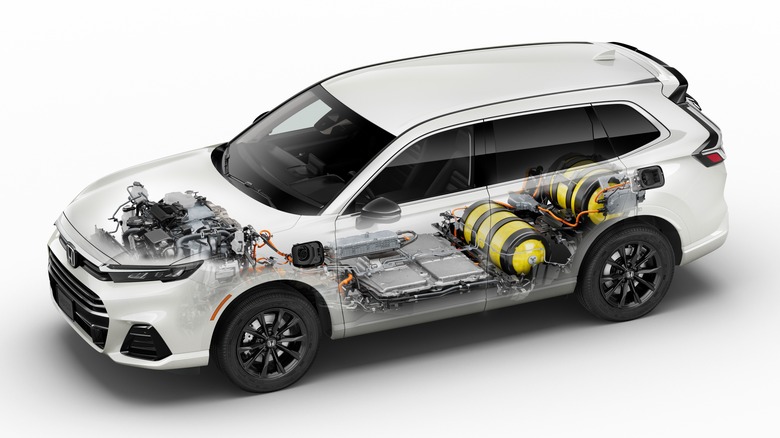
(1) inadequate verification throughout a course of change to cut back the quantity of adhesive sealant resulted in unfilled areas, shortened adhesive size, and decreased sealing efficiency of the FC stack meeting finish joint, and (2) the provider failed to determine a deburring course of for the O-ring groove of the wobble joint, leading to burrs which decreased sealing efficiency. Over time, these situations can enable gasoline cell stack coolant to enter the FC stack case and create {an electrical} quick between the gasoline cell stack bipolar plate and the support-bar housing, resulting in the ground-fault warning.
There are two potential causes for the problem
There are a number of warnings that will happen on the instrument cluster relying on the severity of the problem. The primary warning that will present says “Energy System” when a excessive voltage floor fault is detected. The second will say “FC insulating fluid low, see your seller,” which signifies that your gasoline cell stack coolant has decreased. When air is blended into the gasoline cell stack coolant it’ll learn “energy could also be decreased, see your seller,” and gasoline cell energy output is decreased to twenty kW. The ultimate warning that may seem says both “don’t drive” or “cease driving when protected,” indicating that the gasoline cell stack coolant temperature rises and the gasoline cell energy era has stopped.
Honda already notified sellers of the recall, however homeowners shall be notified on February 2 subsequent yr. The treatment for the problem requires sellers to switch the gasoline cell stack meeting with an improved half that makes use of a rubber finish unit seal as an alternative of an adhesive one, in addition to wobble joints which have been deburred. Honda has had 14 guarantee claims surrounding this challenge as of December 5, and fortunately there have been no stories of damage or demise associated to the recall. There isn’t a listed date when VINs shall be searchable, however the recall impacts automobiles produced between June 3, 2024 and March 26, 2025.